
About Händel

Georg Friedrich Händel 1685-1759
Georg Friedrich Händel (1685-1759) was a Baroque composer renowned for his operas, oratorios, and instrumental compositions. Born in Halle, Germany, Händel showed an early talent for music. At an early age, Handel taught himself to play both harpsichord and pipe organ. Despite his father's wishes for him to study law, he pursued music and began his career as a composer and violinist. At age 18, he moved to Hamburg, where he composed his first operas, including 'Almira' (1705).
In 1706, Händel traveled to Italy, where he composed Italian operas and oratorios, significantly influencing his musical style. After returning to Germany in 1710, he became Conductor (Kapellmeister) to the Elector of Hanover, a German nobleman who was also the heir to the throne of England and became the crowned King George I in 1714, after the death of the childless Queen Anne. Händel also moved to London, where he settled permanently. There, Händel gained fame with his Italian operas such as 'Rinaldo' (1711), 'Giulio Cesare' (1724), and 'Alcina' (1735).
However, the decline in popularity of Italian opera in London led Händel to focus on English oratorios. His most famous work, 'Messiah' (1742), became one of the most celebrated choral works in Western music. Händel composed over 30 oratorios, including 'Samson' (1743), 'Judas Maccabaeus' (1747), and 'Solomon' (1749). He also wrote orchestral music, including the 'Water Music' (1717) and 'Music for the Royal Fireworks' (1749). Handel’s beloved Water Music was composed at the request of King George I to entertain guests at a party held on barges on the Thames River. It is said that the king loved the music so much, that he commanded it to be played three times that evening.
Händel's music was known for its dramatic flair, melodic inventiveness, and grand choruses. He became a naturalized British citizen in 1727, and despite suffering from blindness in his later years, he continued to compose. Händel died in London in 1759 and was buried in Westminster Abbey with full honors. Messiah was played at his funeral. A number of charities were the beneficiaries of Händel's estate..
His music, particularly his oratorios, remains a cornerstone of the Baroque repertoire with 'Messiah' becoming a landmark in music history.
About Händel's Messiah

Händel ‘s Messiah is one of the most celebrated works in the classical music repertoire, revered for its grandeur, emotional depth, and spiritual uplift. Composed in 1741 by George Frideric Händel, this English-language oratorio is best known for its "Hallelujah" chorus and has become a centerpiece of holiday celebrations worldwide, especially during the Christmas season.
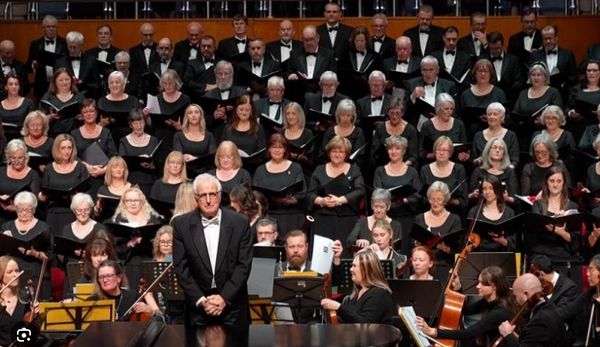
On November 30th under the baton of Malcolm Green, the Limerick Choral Union will perform Messiah 2024 at University Concert Hall Limerick, continuing the choirs beloved biennial tradition
Remarkably, at 56 years of age, Händel composed Messiah in a mere 24 days beginning on August 22nd 1741.The work's text was compiled by Charles Jennens, a wealthy literary scholar and devout Anglican, who drew directly from the King James Bible and the Book of Common Prayer to create a libretto that focuses on the prophecy of the Messiah, the birth, passion, and resurrection of Jesus Christ, and the ultimate redemption of humanity. The oratorio is divided into three parts: the first centered on the prophecy and birth of Christ, the second on his passion and resurrection, and the third on the promise of eternal life
Though it has become a Christmas season staple, Messiah was originally intended as an Easter piece. It premiered in Dublin, on April 13, 1742, during Lent.
The work received a warm reception, with over 700 people attending the debut performance—a significant turnout at the time. Messiah was initially performed in concert halls rather than churches, which sparked controversy among some audiences who felt such sacred music should be reserved for religious spaces.
It was the Victorians who shifted Messiah to the Christmas season to revive interest in the then-neglected holiday. By the late 19th century, it became a December tradition
Händel‘s messiah is a masterclass in the baroque style and demonstrates a brilliant interplay between orchestral and choral performance. It features a wide range of musical forms, from majestic choruses like "For Unto Us a Child Is Born" and the iconic "Hallelujah" chorus, to intimate arias such as "He Was Despised" and "I Know That My Redeemer Liveth." The choruses “And He Shall Purify,” “For Unto Us a Child Is Born,” and “His Yoke Is Easy” were adapted from Italian love arias Händel had written two decades earlier.
It is customary for audiences to stand during the famous “Hallelujah” chorus. This tradition supposedly began when King George II, moved by the music at the London premiere, stood up, prompting the rest of the audience to follow suit to avoid offending the king and the custom has endured ever since.
The legacy of Händel’s Messiah is not just in its music but in its capacity to inspire and move audiences centuries after it was written. Composers like Beethoven and Mozart openly admired Handel, with Beethoven once calling him the "greatest composer who ever lived." Mozart declared that, in the face of Händel‘s genius, he felt "to be humble."
Beyond the concert hall, Messiah has become part of popular culture, its themes of hope, redemption, and divine glory resonating with audiences of all backgrounds. Whether experienced in a grand cathedral or a modern concert hall, Händel’s Messiah continues to captivate and inspire, a true masterpiece much celebrated.
About Limerick Choral Union
Limerick Choral Union (LCU) is one of the city’s longest-established choirs, proudly celebrating 60 years of musical excellence. Since its founding in 1964, LCU has been dedicated to nurturing new talent and delivering thrilling choral performances under the expert musical direction of Malcolm Green.
As a proud ambassador of Limerick, LCU showcases the city’s rich musical talent on both local and international stages. The choir has toured extensively, performing in countries such as France, Bulgaria, Poland, Slovenia, Italy, and England. Over the years, LCU has collaborated with numerous choirs and earned accolades, including the Best Limerick Choir award in 1997.
LCU is a welcoming community for both professional and non-professional singers. Open auditions are held every September and January, inviting anyone who can sing in tune to join the ranks. Each year, the choir presents two major performances at the University Concert Hall in Limerick, participates in choral festivals, embarks on international tours, and performs at special events such as the Limerick Sings festival and the Mental Health Awareness concert.
Generations of families have been part of the LCU tradition, with members often joining alongside their parents, siblings, or spouses. This sense of community, pride, and shared accomplishment has been the cornerstone of LCU’s enduring success.
LCU is a dynamic and progressive choir, constantly expanding its repertoire and challenging both members and audiences with complex and diverse choral works. Singing in multiple languages—Irish, French, German, Latin, Italian, and Russian—LCU continues to inspire and captivate with every performance.
About Our Conductor and Musical Director

Malcolm Green
Originally from London, Malcolm Green has made Limerick his home for the past 25 years and has been at the helm of Limerick Choral Union for an impressive 31 years.
As the longest-serving musical director in LCU's 60-year history, Malcolm has led the choir through countless performances, bringing major choral works to Limerick and guiding the choir in international festivals across Europe.
In September 2022, Malcolm led the choir to Sardinia to participate in a choral festival.
Malcolm's musical journey began with a degree in music, followed by specialising in piano performance at the Royal Academy of Music in London. His career in England included teaching piano at the tertiary level, running a successful children's music school, and playing cello in a trio. For 20 years, Malcolm was also a member of the Essex Chamber Orchestra, where he also played cello.
In 1995 he formed the Dolmen String Quartet which played for weddings, corporate events and concerts such as the President’s summer garden party at the Áras. The Quartet also featured on RTE Sunday’s Miscellany.
Beyond LCU, Malcolm has conducted various orchestras and collaborated with renowned musicians such as Alexander Anissimov, Sir Karl Jenkins, Gavin Malone, and Bill Whelan.
His commitment to the community extends to his role as the organizer of the National Choral Singing Day concert in conjunction with Limerick Mental Health, an event he has overseen for the past 17 years. In 2022, after the challenges of the pandemic, he successfully brought together over 150 choristers to perform in St. Mary’s Cathedral.
During the first lockdown in 2020, Malcolm returned to regular piano practice, resulting in several recordings of beloved piano pieces that he shared online, reconnecting with his passion for performance.
In addition to his musical accomplishments, Malcolm holds an M.A. in Integrative Psychotherapy from University College Cork (UCC) and serves as the Director of the Crescent Counselling and Psychotherapy Centre in Limerick, where he continues to contribute to the well-being of his community.